

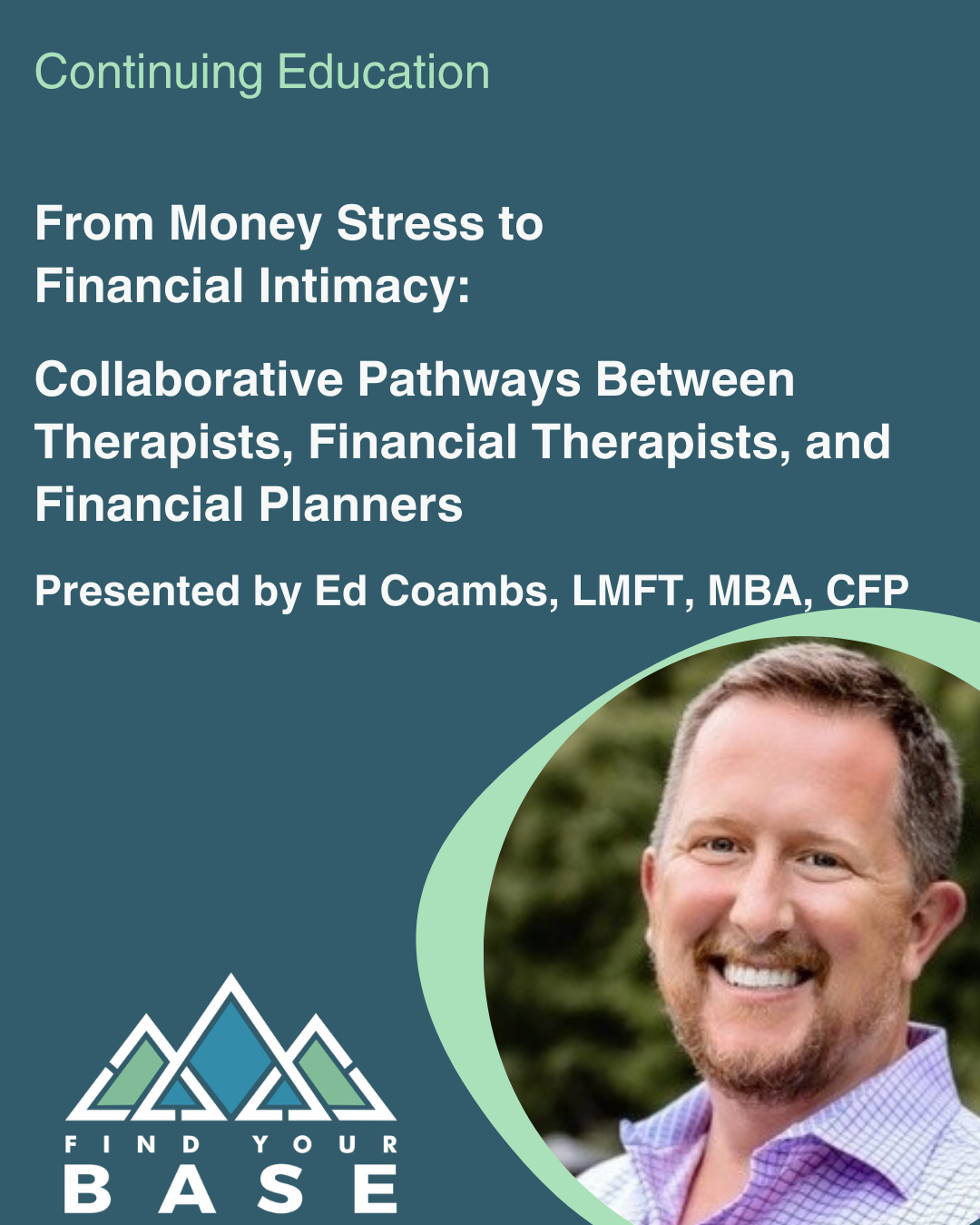
From Money Stress to Financial Intimacy
PRESENTED BY ED COAMBS, LMFT, MBA, CFP
Webinar Based Exam
1.25 CONTINUING EDUCATION CREDITS
BASE is approved by the American Psychological Association to sponsor continuing education for psychologists. BASE maintains responsibility for this program and its content.
DESCRIPTION
Money is one of the most frequent and enduring sources of relationship conflict—and one of the least comfortably discussed in therapy. Yet empirical research consistently shows that financial stress and communication patterns predict both relationship satisfaction and dissolution (Peetz et al., 2023; Saxey et al., 2024). Attachment research adds further nuance, revealing that anxious and avoidant attachment styles amplify money-related tension and avoidance in couples (Pollmann, 2021; Li et al., 2023). Therapists often recognize that “money is the fight,” but lack tools to assess, treat, or refer clients for specialized help.
This workshop provides an evidence-based framework for recognizing financial dynamics as relational dynamics—where attachment patterns, trauma histories, and money behaviors intersect (Ross, Coambs, & Johnson, 2022). Participants will explore how these dynamics become even more layered in second and blended marriages, where loyalties, family roles, and histories with money complicate trust and transparency. Recent research highlights that financial infidelity and hidden spending are more prevalent in stepfamilies and remarriages, creating challenges around autonomy, fairness, and legacy (Van Cleve, McWhorter Keamo, Lutter, & Yorgason, 2024). Understanding these relational nuances allows clinicians and financial professionals to tailor interventions that balance individual security with collective stability.
Participants will also learn how visualizing a couple’s shared financial life—through dashboards, timelines, and asset maps—can help partners build a joint understanding of their finances, even when accounts are separate, reducing avoidance and increasing alignment (Kothakota & Kiss, 2020; Lusardi, Keller, & Keller, 2017). The presentation further addresses ethical considerations when collaborating with financial professionals, including the fiduciary standard, compensation models, and transparency practices that affect couples’ sense of safety and autonomy (Bearden, 2023).
LEARNING OBJECTIVES
Based on the content of this workshop, you will be able to:
Summarize empirical findings on how financial stress, account structures, and communication patterns affect couples’ relational satisfaction and stability.
Identify behavioral and emotional red flags—such as secrecy, control, avoidance, or chronic asymmetry—that suggest the need for financial therapy or planning collaboration.
Explain how visualization tools (financial dashboards, cash-flow maps, and goal timelines) enhance couples’ shared financial understanding, even with separate accounts.
Describe the fiduciary standard and evaluate compensation models in financial planning (fee-only, commission, hybrid) as part of ethical referral decision-making.
Implement a collaborative referral process that upholds confidentiality, informed consent, and coordinated care between the therapist and the financial professional.
AUDIENCE
Licensed psychologists and allied mental health professionals providing individual/couple therapy who want evidence-based guidance on assessing money dynamics and collaborating with financial therapy/planning specialists.
RESOURCES
Addo, F. R., & Zhang, X. (2020). Debt concordance and relationship quality among married and cohabiting couples. Journal of Family and Economic Issues, 41(3), 433–449. https://doi.org/10.1007/s10834-020-09678-0
Certified Financial Planner Board of Standards. (2021). Code of ethics and standards of conduct. CFP Board.https://www.cfp.net/ethics/code-of-ethics-and-standards-of-conduct
Bearden, F. C. (2023). Remedies to Avoid the Subtle Influence of Conflicts of Interest in Financial Planning: Whether pecuniary or personal, conflicts of interest prevent financial planners from serving clients effectively. Journal of Financial Planning, 36(4).
Kothakota, M. G., & Kiss, D. E. (2020). Use of Visualization Tools to Improve Financial Knowledge: An Experimental Approach. Journal of Financial Counseling and Planning, 31(2), 193-208.
Lusardi, A., Keller, P. A., & Keller, A. M. (2017). Visual tools and narratives improve financial literacy: Evidence from field experiments. Journal of Pension Economics & Finance, 16(3), 297–322. https://doi.org/10.1017/S1474747215000323
Olson, J. G., Rick, S. I., Small, D. A., & Finkel, E. J. (2023). Common Cents: Bank Account Structure and Couples' Relationship Dynamics. Journal of Consumer Research, 50(4), 704-721. https://doi.org/10.1093/jcr/ucad020
Peetz, J., Babcock, M. J., & Davydenko, M. (2023). When couples fight about money: Frequency, topics, and relational outcomes. Journal of Family and Economic Issues, 44(2), 401–417. https://doi.org/10.1007/s10834-022-09869-5
Saxey, M. T., Archuleta, K. L., & Britt, S. L. (2024). Development and validation of the Couples Financial Communication Scale (CFCS). Journal of Family and Economic Issues, 45(2), 231–247.https://doi.org/10.1007/s10834-024-09977-5
Steuber, K.F., & Paik, A. (2014). Of money and love: Joint banking, relationship quality, and cohabitation. Journal of Family Issues, 35(9), 1154-1176.
PROFESSIONAL AND ETHICAL ISSUES
There is no commercial support for this CE program, instructor, content of instruction, or any other relationship that could be construed as a conflict of interest. There is no endorsement of products.